
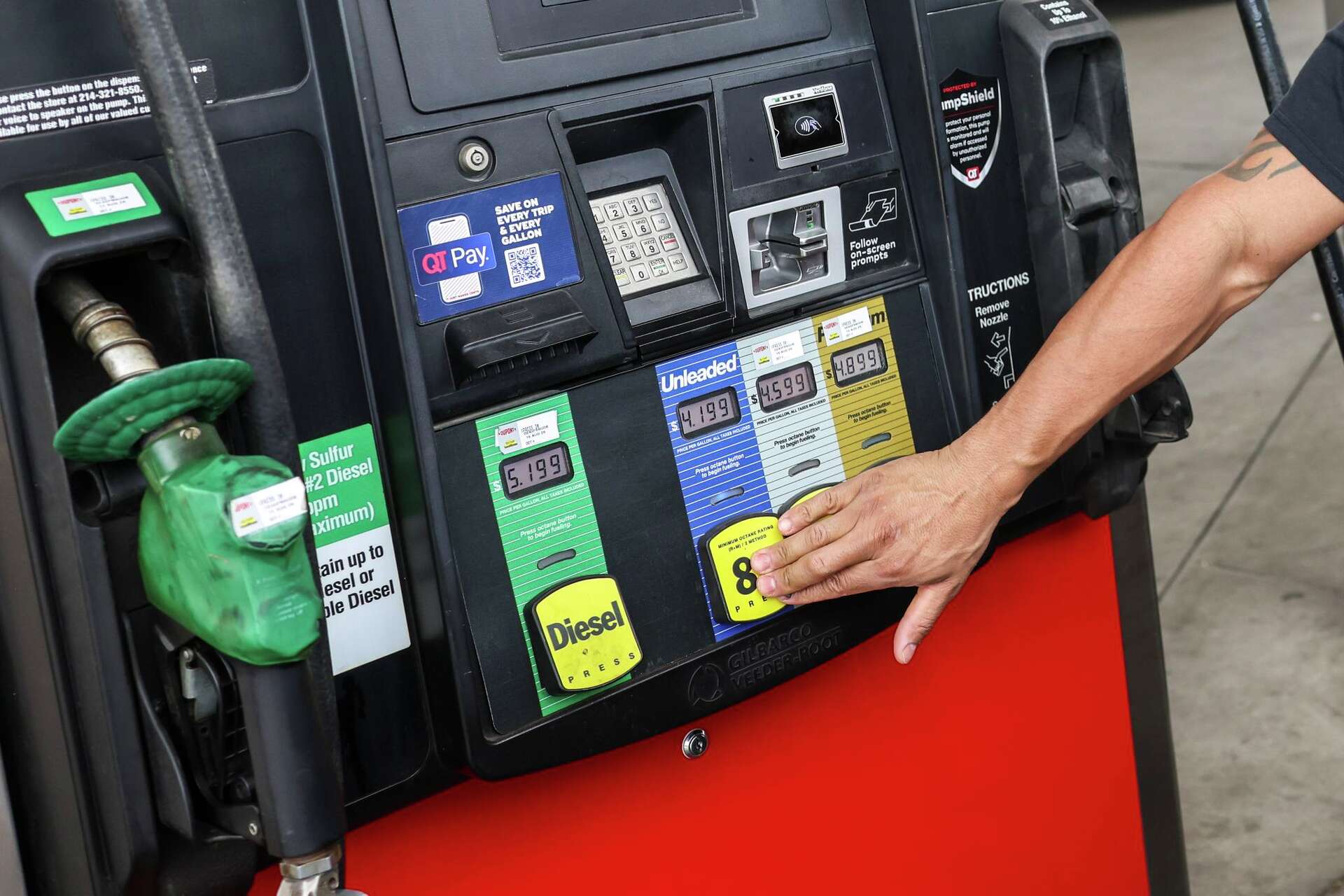
Alex Viloanueva of Garland hits the button as he pump gas at a Quicktrip station in East Dallas on Thursday, May 7, 2026.
Shafkat Anowar/The Dallas Morning NewsRising gas prices are continuing to strain the wallets of North Texans. For some, this means a lot more than just cutting back on spending.

“Can I feed my kids? Can I pay for gas? Can I make my rent payment?” These are the questions Susan Hoff, chief strategy and impact officer for United Way of Metropolitan Dallas, is helping people answer. Hoff said United Way partners with over 200 nonprofit organizations to serve around 1.7 million people per year across Dallas, Collin, Rockwall and Denton counties.
Now that school is out for the summer, Hoff only expects the need for education and financial support services to increase.
Article continues below this ad
Gas prices in North Texas
The ongoing war between the U.S., Israel and Iran has had a lasting impact on gasoline prices across the country. Since Memorial Day, prices remain on a downward trend, offering some relief to North Texans, but the continued closure of the Strait of Hormuz is keeping prices well above last year’s average.
Local nonprofits, such as Sharing Life, the Salvation Army of North Texas and United Way of Metropolitan Dallas have seen an increase in resident need due to the increased cost of oil. This includes rental assistance and financial need for basic necessities like groceries. These prices have also affected donations. Typically in times of increased need, Sharing Life CEO Teresa Jackson notices people with the means to donate will. This has not been the case this year, though.
“The price that everybody’s paying for gas, groceries, utilities, mortgages and taxes, all of that has risen so sharply in the past year that many people are having to cut back on giving as part of their discretionary budget, so we really need more help right now than we would normally be,” Jackson said.
Article continues below this ad
Data from petroleum analyst Patrick De Haan at GasBuddy indicated pre-war averages in Texas remained around $3 per gallon earlier this year. In April, average prices for gasoline reached an average of $5.20 per gallon. In Dallas, that has dipped to $3.55 on June 8, but still is above $4 a gallon in other parts of the state.
A poll by health policy organization KFF found the rising costs of gasoline and other transportation have become U.S. adults’ top affordability concerns, tied with healthcare. Sixty-four percent of respondents expressed being “very” or “somewhat worried” about gas and transportation for themselves and their families.
A study from financial services company Motley Fool Money found that, as of April 30, the average Texan is spending $216 per month on gasoline.
Related: Texas gas price tracker
North Texas families feel deep financial strain
Not everyone is feeling the price increases equally. In North Texas, these costs are placing increased pressure on already strained budgets of families living near or below the poverty line.
Article continues below this ad
High prices have a “domino effect” on the choices North Texans have to make, Hoff said.
“If you’re already living close to the line where your budget is so tightly managed that one thing throws everything off, increased fuel prices absolutely can be one of those things that throw everything out of balance,” Hoff said.
At Sharing Life, a safety net organization providing services to North Texans experiencing financial difficulty, Jackson has seen families navigating how to balance paying for basic needs such as food, medications and daycare. A rise in price for one of these categories like gas can quickly snowball.
“Many are just one crisis away from beginning that journey [to being unhoused], so when something significant happens like an almost $2 gallon difference in gas, they have to make decisions,” Jackson said. “They have to go to work to be able to survive, but putting the gas in the car means they have to find something else to cut back on.”
Often, Jackson said, this sacrifice is food. She said Sharing Life has seen an increase in need for their food pantry services, causing the organization to expand their hours of operation.
Article continues below this ad
The Salvation Army of North Texas has also seen an increase in need at their food pantries, which serve Dallas, Collin, Denton, Tarrant, Ellis and Rockwall counties.
Managing Director Christina Cavalier said nine of the organization’s 13 food pantries have seen a “very high” average of a 26% increase in first time food pantry clients since January. According to Cavalier, the organization has also seen an increase in utility assistance requests and financial assistance requests.
As for the city of Dallas, Communications Administrator Robyn Gerard said in a written statement that the Office of Housing and Community Empowerment has not seen evidence of increased need due to rising gas prices. On the other hand, the city of Fort Worth’s Community Action Partners reports a rise in need for their support services.
Michelle Doonkeen, Fort Worth’s assistant director of neighborhood services, said CAP provides utility assistance, emergency rental assistance and case management to residents as they transition out of poverty.
“We’re doing everything we can to help people and the crisis they’re in, but these rising gas prices are just one more layer of stress,” Doonkeen said.
Article continues below this ad
She added that the rise in gas prices has come alongside other cost of living increases.
“What we’re seeing with the gas prices is that rent is skyrocketing, food is skyrocketing, gas prices are skyrocketing, people are not able to pay,” Doonkeen said.
The impact of commuting
The nature of Dallas-Fort Worth as a commuter-heavy region heightens the impact of increased gas prices.
If gas prices remain high, Hoff fears they will impact people’s ability to get to work, especially those without reliable access to public transportation.
Article continues below this ad
Gabe Madison is CEO of Metrocrest Services, a nonprofit serving families in Carrollton, Farmers Branch, Addison, Cooppell and some areas of Dallas through its food pantries and temporary financial assistance, she said.
Recently, Madison recounts some North Texans have come to her and said, “I had to take off work a day or two this week because I couldn’t afford the gas to get to work.”
Her organization helps distribute gas cards and DART transportation passes. Madison said clients have been working with Metrocrest to understand how to use DART.
Govind Iyer, a professor and director of the Center for Energy Accounting and Sustainability at the University of North Texas, spoke to D-FW’s unique dependence on transportation. Unlike other large cities such as Boston, New York and Washington D.C., Iyer said Dallas is difficult to navigate without a car.
He estimated most people in the area commute for an average of 30 minutes per day, deeming transportation necessary for almost all residents.
Because this transportation is necessary to complete daily tasks such as getting to work, getting children to school and running errands, high gas prices quickly become a larger issue for Dallas-Fort Worth residents than people in other cities.
Iyer sees two groups of people impacted by increased gas prices: those who need to commute to work and those who need gas in order to complete the work itself.
Teachers, service workers and nurses were among those he said absolutely have to commute to work. For delivery drivers, ride hailing drivers and people offering trades for clients in different locations, the impact is even higher, as gas is directly part of their working budget.
”If gas prices go up 20%, their earnings go down 20%, meaning they have less money now for other things like buying food, going to movies or restaurants or buying clothes,” Iyer said.
Iyer said there’s not much people can do to adapt to these higher prices, because predicting gas prices in the long term is nearly impossible, and making “dramatic changes based on short term fluctuations” is not something he would advise.
“It doesn’t impact everybody equally,” Iyer said. Lower and middle income North Texans will be hit hardest by these raised prices, as gas prices are a larger proportion of their budget.
Summer months see heaviest financial strain
The leaders of the Salvation Army of North Texas, United Way of Metropolitan Dallas, Sharing Life and Metrocrest Services agree summer brings additional challenges to North Texan families as they navigate financial pressures.
Cavalier said when children are off school for the summer, families have to balance paying for gas with child care and feeding their children.
Madison says parents are becoming more reliant on summer feeding programs because of the increases in gas prices coupled with rising utility prices. “These things are impacting our neighbors in grave ways,” she said.
Jackson said summer is one of the “hungriest seasons of the year,” so her organization has been working to increase its summer meal replacement services for the season.
Both Jackson and Madison noted these gas prices have come as SNAP benefit cuts have already placed strain on their organization’s resources and brought in a slew of new clients.