
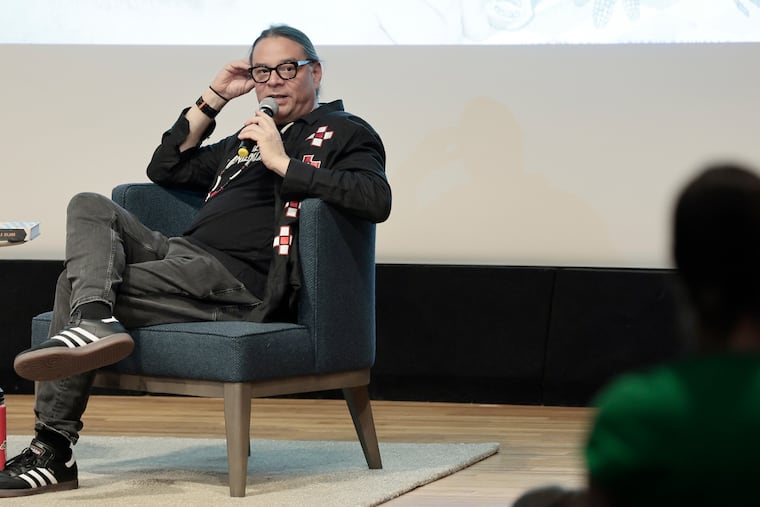
Kids today can “name more Kardashians that types of trees,” according to Sean Sherman, a James Beard Award-winning Oglala Lakota Sioux chef, activist, and cookbook author.
They — and their parents, for that matter — know almost nothing about the forests, plants, and animals that fed Sherman’s Native American ancestors and cultivated whole nations of Indigenous people, he said in a talk Saturday at the Academy of Natural Sciences of Drexel University.
Sherman was on hand to discuss his new book, Turtle Island: Foods and Traditions of the Indigenous Peoples of North America, which includes 100 ancestral and modern recipes.
In his career, Sherman has won the 2018 James Beard Award for Best American Cookbook for his book, The Sioux Chef’s Indigenous Kitchen; the James Beard Leadership Award in 2019 for his dedication to revitalizing Indigenous food systems; and the 2022 James Beard Award for Best New Restaurant, for his Minneapolis restaurant, Owamni (co-owned with Dana Thompson).
Sherman is famous for, among other dishes, wild rice-crusted walleye, cedar-braised bison, and hunter’s stew with bear meat (or lamb if bears are scarce).
He said he learned his craft the hard way.
“I couldn’t very well go online to learn how to do Native American cooking,” said Sherman, 52, who was born on the Pine Ridge reservation in South Dakota, and now lives in Minneapolis. “Nothing was there. So much of it was lost to history so quickly.”
He read academic books on plants that were used as food and medicines by Native Americans. He learned how to prepare the game meats that provided protein to long-ago ancestors. And he worked in Minnesota restaurants to cook what he calls “colonial food,” derived from European cuisines, to hone his chops in the kitchen.
Many Native Americans have long been unaware of the knowledge gleaned by their forebears. Showing a slide of a bologna sandwich on white bread, Sherman told the 240 people in his audience, “This was Lakota food when I was young.” Also on the menu: unadorned cans bearing the words, “Beef with juices.”
Sherman is wry with a biting wit — “lawns are [expletive] stupid, aren’t they?”
He also shows little reverence for the 250th celebration of the signing of the Declaration of Independence, dismissing the document as a “break-up letter to King George” that described Sherman’s ancestors as “merciless Indian savages.”
When Sherman was done, the crowd moved outside to the Benjamin Franklin Parkway, where ethnobotanist Linda Black Elk, director of education for NATIFS (that’s North American Traditional Indigenous Food Systems), was holding court.
She showed visitors a garden of plants used by Indigenous people that grow easily in Philadelphia, and can be harnessed for use.
Anise hyssopcan be made into a tea that’s “good for the lungs, and helped during COVID,” Black Elk said.
Mountain mint, which battles indigestion, was growing near elder flowers, “one of the most anti-viral plants in the world,” according to Black Elk. “And you can simply grow it in your yard.”
Black Elk added that the well-known “three sisters” — squash, corn, and beans — easily grow at Philadelphia’s latitude as well.
Impressed by the plants, as well as Sherman himself, Lucas Figueroa, 28, of South Philadelphia, an AmeriCorps VISTA volunteer, said, “Food connects everybody to culture and the land. I’m so very passionate about this.”
Sara Marine, 51, an archeologist from Lancaster, praised Sherman for not merely trying to recreate the past, but for “bringing it to life.”
Steps from the garden, visitors were treated to snacks with Native American roots that can be made today with local ingredients: aronia berry granola (with oats and flax seed); sumac honey spritz (made with seltzer); and cornmeal elderberry cookies (sweetened with maple sugar).
Sherman said he wanted his audience to understand that he doesn’t like simply telling people, “this is how we cooked in 1491.” Rather, he said, “I want to show people that we’re moving forward … coming up with food that can be beautiful and hopeful.
“This is real American food. That label isn’t just for the hamburger.”
Sherman’s appearance was presented in partnership with ArtPhilly’s What Now: 2026 festival and WHYY. The event is connected to the Academy’s new exhibition Botany of Nations, on view through Feb. 14, 2027.