
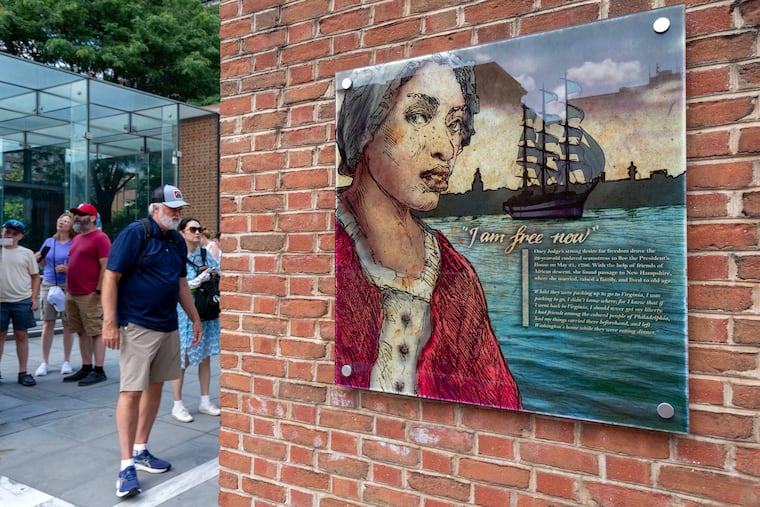
On May 21, 1796, Ona Judge escaped to Philadelphia’s free Black community after years of enslavement at the hands of George and Martha Washington.
Judge, as one of nine people enslaved by Washington during his presidency in Philadelphia, then spent several years dodging attempts from the first president to recapture her.
Almost 230 years later, Judge’s determination and pursuit for freedom is officially being honored by the City of Philadelphia.
Philadelphia City Council last week adopted a resolution, introduced by Councilmember Cindy Bass, a Democrat, to officially recognize May 21 annually as “Ona Judge Day.” The designation comes at a key moment as President Donald Trump’s administration continues their efforts to rewrite Washington’s role in upholding slavery in Philadelphia.
The first city-recognized “Ona Judge Day” next month will also come just weeks ahead of the height of the nation’s 250th anniversary celebrations this summer.
Judge’s story is prominently featured at the President House’s site, which opened in 2010 to memorialize Judge and the other eight people enslaved by Washington in the city.
But that story has targeted by the Trump administration for removal ahead of the 250th anniversary, which makes the city’s decision to establish an official commemoration that much more significant this year.
Here’s what to know.
Who is Ona Judge?
Judge was one of nine people enslaved by George and Martha Washington at their residence in Philadelphia.
She was a maid and seamstress and, along with other individuals enslaved at the residence, Washington rotated her every six months between Philadelphia and his residence at Mount Vernon in Virginia to subvert an emancipation law in Pennsylvania.
Judge’s escape to freedom was motivated by her desire for liberty and to flee being passed on to Martha Washington’s oldest granddaughter who had a “fierce temper,” according to historians at Mount Vernon.
“Whilst they were packing up to go to Virginia, I was packing to go, I didn’t know where; for I knew that if I went back to Virginia, I should never get my liberty,” Judge said, according to the historians. “I had friends among the colored people of Philadelphia, had my things carried there beforehand, and left Washington’s house while they were eating dinner.”
Eventually, Judge arrived in New Hampshire, but still had to grapple with Washington’s several unsuccessful attempts to retrieve her.
Judge’s story, and that of the eight people she was enslaved with, is currently honored at the President’s House, pending the Trump administration’s court appeal to rewrite them.
Who is behind the efforts to honor Ona Judge?
Several stakeholders throughout the city have been working to recognize Judge’s story, including Avenging the Ancestors Coalition, which helped shape the President’s House memorial in the early 2000s and has been leading current efforts to protect the site.
Since 2003, ATAC has routinely recognized Judge on May 21, but the coalition is grateful to City Council for making the designation official, said Dawn Chavous, spokesperson for the organization. Chavous’ husband is City Council President Kenyatta Johnson.
Last week, The Citizen Group, which owns Philadelphia Magazine and the Philadelphia Citizen, started a petition to recognize Judge on May 21 with support from ATAC founder Michael Coard and Carl Stingley, founding member of the Ona Judge Coalition.
Given ATAC’s continuous remembrance of Judge, “We therefore enthusiastically, energetically, and ecstatically support the creation of an official local, state, and federal Ona Judge Day,” Coard said on the petition website.
Why does this matter right now?
The commemoration of Judge’s story is especially pertinent as the fight to preserve the President’s House continues to unfold after the Trump administration removed exhibits at the site earlier this year.
Panels and videos detailing Judge’s story were removed earlier this year after the federal government dismantled the exhibit in alignment with directives from the Trump administration.
Most of the site’s panels were restored after an order from a federal judge, but the future of the President’s House remains in limbo as the City of Philadelphia’s legal battle against the federal government continues to shake out.
Attorneys for the city and the Trump administration are scheduled to appear in the Third Circuit Court of Appeals on June 2nd for oral arguments over the government’s effort to overturn the injunction prohibiting changes to the President’s House.
Earlier this month, the Trump administration’s vision for how they would reshape history at the President’s House was revealed. The Inquirer reported on a set of digital renderings quietly uploaded online by the Trump administration that completely reframed Washington’s role as an enslaver and diluted the stories of the people he enslaved.
Judge’s recognition also comes just weeks ahead of what’s expected to be an influx of tourism for the city’s celebrations for 250 years since the nation’s founding.
City Council’s resolution emphasizes that Judge’s story is “a critical part of both Philadelphia’s and the nation’s history, illustrating the contradictions between the ideals of liberty and the realities of slavery in the founding of the United States.”
Staff Writer Abraham Gutman contributed reporting.