
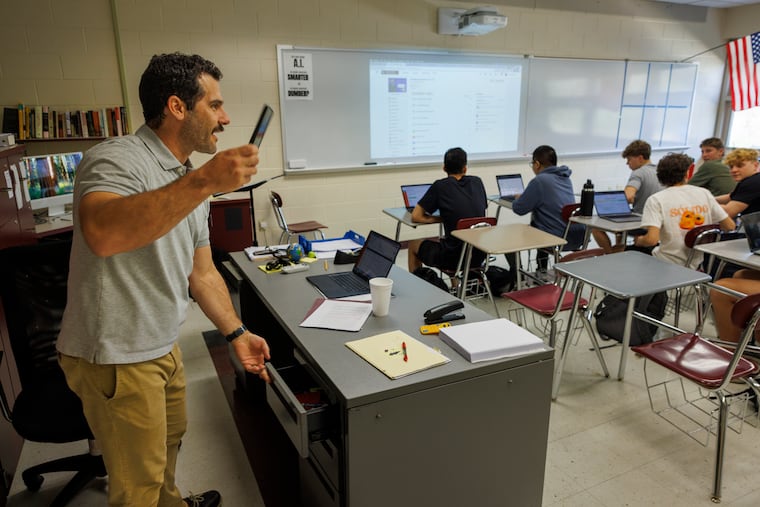
Pennsylvania lawmakers this week passed a bill banning cell phones in schools, joining states across the country amid mounting backlash to technology in classrooms and social media addiction.
Gov. Josh Shapiro, who previously called for a so-called “bell-to-bell” ban, is expected to sign it into law soon.
“It’s time to get back to the basics in school and let our kids be kids,” the Democratic governor said in a post on X Wednesday, after both the House and Senate had passed the bill.
The bill will require schools to bar kids from using cell phones throughout the school day, starting next fall. Here’s what to know about the new rule and how schools are reacting:
A ban on ‘mobile devices’
Under the bill, both public and private K-12 schools will be required to prohibit students from using personal mobile devices from the start of the school day to the end.
That applies to cell phones, but also other internet-connected devices, like smartwatches, according to the bill.
Thirty other states — including New Jersey — have already passed bell-to-bell cell phone bans, according to Education Week.
Before the 2027-28 school year begins, Pennsylvania schools will have to adopt policies describing how they intend to prohibit students from using their phones.
“For too long, access to a phone-free school day depended on which school a student attended,” Alex Bird Becker, a Wallingford-Swarthmore parent and co-lead of PA Unplugged, a statewide advocacy group, said in a statement. “Once this law takes effect, every student in the Commonwealth will have freedom from addictive algorithms, from the first bell to the last.”
Exceptions for medical and special needs
The bill allows a number of exceptions for “limited use” of a phone:
-
Students who need phones due to a medical condition
-
Students with individualized education plans or 504 plans that require phones as an accommodation
-
Students who are English learners who use phones for translation
Teachers can also permit students to use phones “for instructional purposes,” if a school-issued device is inadequate or unavailable and the principal approves the use, according to the bill. Principals can also apply to their chief school administrators for exceptions.
The law was supported by the Pennsylvania State Education Association, the state’s largest teachers union. President Aaron Chapin said the law “takes an essential step toward reducing distractions for students during class time and keeping lessons and teaching on track.”
How schools are responding
While most school districts already have policies related to cell phones in place, the bill will require many districts to restrict phones more than they already have. Many area high schools allow students to use their phones in between classes and at lunch, which will now be barred by the bill.
At the 1,600-student Garnet Valley High School in Delaware County, “we don’t have the manpower” to have staff at three different entrances used by students, telling them to put their cell phones away, said Superintendent Marc Bertrando.
Instead, he expected responsibility would fall to first-period teachers — and teachers throughout the day, given a lack of adequate supervision to enforce a ban in hallways between classes.
While “you try to minimize conflict points with students,” Bertrando anticipated more conflict as a result of the ban, “especially if we’re going to get down to the level of, ‘Let me see that watch.’” He also predicted pushback from parents used to being able to reach their children directly during the school day. (The bill says schools must provide parents with a phone number or email address to be used for receiving messages during school.)
Bertrando noted that Garnet Valley had worked to produce a policy supported by teachers, parents and students that restricted, but didn’t bar middle and high school students entirely from using cell phones during the school day.
“To take that away from us is incredibly frustrating,” Bertrando said.
» READ MORE: This Philly-area school district is standing by its decision not to take phones away from kids
The Pennsylvania School Boards Association believes “elected school boards should retain the flexibility to determine the approach that best serves their students and communities,” said spokesperson Mackenzie Christ.
While Pennsylvania previously offered schools money to buy lockable cell phone pouches, few took the state up on the offer.
A number of districts have been preparing for new restrictions. Lower Merion in Montgomery County, which has faced parental pressure to adopt a bell-to-bell ban, has said it would enact one in 2027-28, regardless of whether the state required it.
The Philadelphia School District currently allows individual schools to set their own cell phone rules, though the system-wide policy now says that district students “should not use cell phones or wearable devices in classrooms unless permitted by a school staff member, or permitted by this policy expressly. Each school shall create their own protocols that designate areas within the school and times of day where student use of cell phones” during school hours.
That looks different in different buildings. Some schools require students to lock cell phones up in lockers outside the building; others require students to place phones in sealed pouches. In some cases, students have access to phones in hallways and the cafeteria, but surrender phones when entering individual classrooms.
The district did not immediately react to the new law, or comment on how it might change its policy.
Inquirer staff writers Kristen A. Graham and Gillian McGoldrick contributed to this article.