
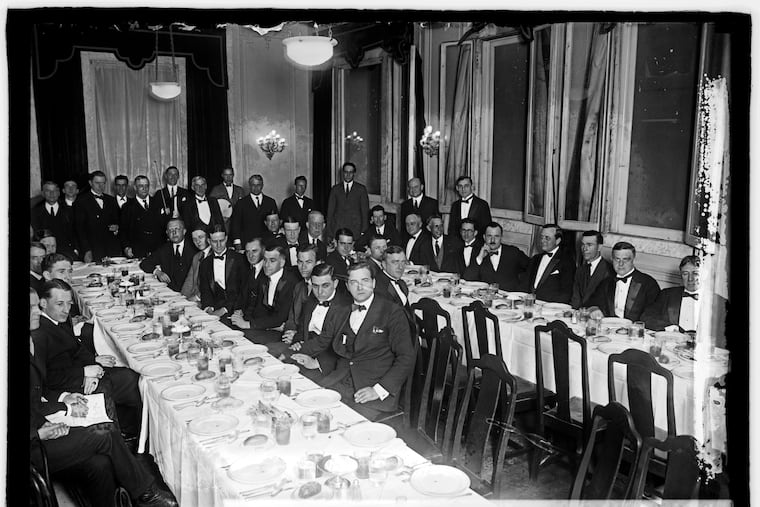
WASHINGTON — An hour after a gunman rushed a security checkpoint at the Washington Hilton last month and shut down the White House Correspondents’ Association dinner, President Donald Trump declared that it would be rescheduled within 30 days. By his calendar, an event attended by 2,570 people will be held May 25 at the latest.
Never mind that Trump is not the host of the event. Very few think the date is realistic, at least for the kind of blowout that the dinner has become.
But as the association’s board tries to figure out the timing and type of a redo, a bigger debate than usual is swirling around one of Washington’s most dissected rituals. Critics have long called the dinner a distasteful, too-cozy fete for reporters and the powerful people they cover. Defenders say it is a celebration of the First Amendment and a fundraiser for more than $100,000 in college journalism scholarships.
Never has it been what it became April 25 — the site of what prosecutors say was a presidential assassination attempt and a potential mass casualty event. Current and former participants now question whether the dinner has outlived its rationale, given the heightened security concerns and the fact that on a night meant to honor journalists, Trump — who is suing multiple news organizations and routinely attacks the press — planned to “really rip” the media, as he put it, in the “most inappropriate speech ever made.”
“I would have stuck a fork in it a long time ago,” said Graydon Carter, a former editor of Vanity Fair who for eight years hosted, with Michael Bloomberg, the most exclusive of the dinner’s after-parties. “Make it smaller. Make it like a proper dinner. Whatever it was, I would go back to that. Because it’s unsustainable.”
Susan Page, USA Today’s Washington bureau chief and a former president of the correspondents’ association who has attended every dinner since 1980, remains a supporter of the event. Still, she said, “the one thing I think is crucial is that the focus be on journalism, on the role of a free press in a democracy, and on the particular issues that White House correspondents face in covering the president.”
Nicholas Lemann, a former dean of Columbia University’s Graduate School of Journalism and a longtime staff writer at the New Yorker, called the televised dinner “Washington journalism as a Rotary Club meeting,” at odds with the way “we like to present ourselves, as lonely crusaders.”
“We see journalists palling around with public officials, including the competition for who sits at whose table,” he said. “Surely none of this helps reverse journalism’s falling public trust numbers.”
The association’s leadership has said little about its deliberations. The board “is having active conversations about rescheduling the event,” Weijia Jiang of CBS, the group’s president, said in a brief text message. One option favored by numerous White House correspondents is a lunch or more modest dinner, at least this year, to celebrate the award and scholarship winners.
“It’s a very complex decision that involves finances and security and all kinds of other considerations, so we are taking our time to make that decision thoughtfully,” said Trevor Hunnicutt of Reuters, a member of the association’s board.
What is not on the table is having the dinner in Trump’s planned White House ballroom, although the president has used the attack to make the case for his pet project.
“It’s much more secure — it’s drone-proof, it’s bulletproof glass — we need the ballroom,” he said at a news conference in the hours after the attack. But the ballroom faces legal challenges and will not be ready until the end of Trump’s term at the earliest. Members of the correspondents’ association would in any case view holding the event at the White House as a capitulation of its independence.
The dinner has had many permutations in its century-plus of history. It began in 1921 as a small, all-male gathering during the Harding administration. Three years later, Calvin Coolidge became the first president to attend. In the 1940s, it transitioned into a bacchanal with entertainers such as Bob Hope and Sid Caesar. By the early 1980s, it had settled into more of a professional dinner, but with competition over who could nab the best political guests.
Its well-known watershed moment came in 1987, when Michael Kelly, at that time a reporter for the Baltimore Sun, brought as his guest Fawn Hall, a secretary and part-time model who had shredded documents for national security aide Oliver North in the Iran-Contra scandal.
Hall, who married North last year, created such a sensation that the race was on for ever more glittering guests. By 2013, a peak of the Obama Hollywood years, Steven Spielberg, Katy Perry, Kerry Washington, Amy Poehler, Robin Wright, and Claire Danes attended. The next year, some 1,000 ticket seekers had to be turned away.
The 1,000-member correspondents’ association is a nonprofit, and the dinner, its only fundraiser, pays for the scholarships and other costs. The event is expensive, with high costs.
This year, more than 140 news organizations bought tickets at $480 each, the maximum allowed under federal ethics laws for a member of the government to accept free admission to events. As in previous years, many of the television networks bought up multiple tables (CBS had 14) at $4,800 each. The New York Times stopped attending the dinner after 2007.
This year’s dinner was sold out, as has been the case for decades. All the bills are not yet in, according to a person familiar with the workings of the correspondents’ association who was not authorized to speak publicly. It is unclear how much the assassination attempt affected the bottom line.
But the 2025 dinner, similar in size to this year’s, brought in a little more than $1 million in gross receipts, according to the organization’s most recent publicly available tax filing.
Rent and facility expenses for the Hilton were listed at $509,000. Entertainment costs were listed at $43,000, although the correspondents’ association ended up canceling last year’s entertainer, comedian Amber Ruffin, after she referred to the Trump administration as a “bunch of murderers” and the White House objected to her appearance. An additional $43,000 was listed as “other direct expenses.”
A portion of the $480 ticket price was a tax-deductible contribution to the organization. (The tax filing did not list the specific amount that was tax deductible, but for the 2017 dinner it was $125 out of a ticket that cost $300, according to the Columbia Journalism Review.)
Along with other contributions, the 2025 dinner brought in nearly $400,000 for the association, which was used to help pay for close to $23,000 in journalism awards and $140,000 in scholarships. (This year the amount for scholarships was $166,000.) The money also helped cover the expenses of running the organization, including costs for its small office in the Watergate building and the salary of its executive director, Steve Thomma.
Separately, membership dues last year brought in nearly $108,000. The organization also listed $1 million in investments.
One tension over the dinner is the ratio of journalists to other guests, including celebrities, lobbyists, lawyers, agents, and advertisers. The association encourages the media organizations that buy the tables to include working journalists, particularly members of the camera and audio crews who spend long hours at the White House. But many of the media outlets use the evening as a perk for advertisers, or to showcase stars.
Robin Sproul, a former ABC News Washington bureau chief who oversaw the network’s plans for the dinner for 23 years, said there was a big change after Hall burst on the scene.
“Suddenly it wasn’t about getting the labor secretary anymore,” she said. “It became vital to bring in stars from ABC’s primetime entertainment shows, along with sports stars and movie stars.” Over time, she added, “it felt like there was little left that had to do with White House coverage.”
There is no way to know how many working White House journalists actually attend the event, according to the person familiar with the organization’s operations. The media companies that buy tables are asked to send in the names of their guests to include in the dinner program, but only about half of them do. Of the 1,200 names received this year, about a third were White House journalists, the person said.
Kara Swisher, the tech journalist who once helped report on the dinner when she was a news aide for the Washington Post’s Style section in the 1980s, has offered in lieu of the dinner to help fund the scholarships. She thinks that television executives should do the same.
“Some of them are quite wealthy, those broadcast people,” she said. “Each of them could give $10,000, $20,000, and raise the money quite quickly.”
As for the dinner, “the whole thing looks insane that it goes on,” Swisher said. She has never been a fan, but the prospect this year of journalists sitting through a diatribe against the media from Trump was to her a new low. “If that speech had happened, what were they going to do?” she said. “Get up and walk out? What were they doing there in the first place?”
Page disagrees. “It would have been interesting to see what President Trump was going to say at the dinner, and how Weijia Jiang would respond,” she said. “I’m sort of sorry we didn’t get to have that.”
This article originally appeared in the New York Times.