
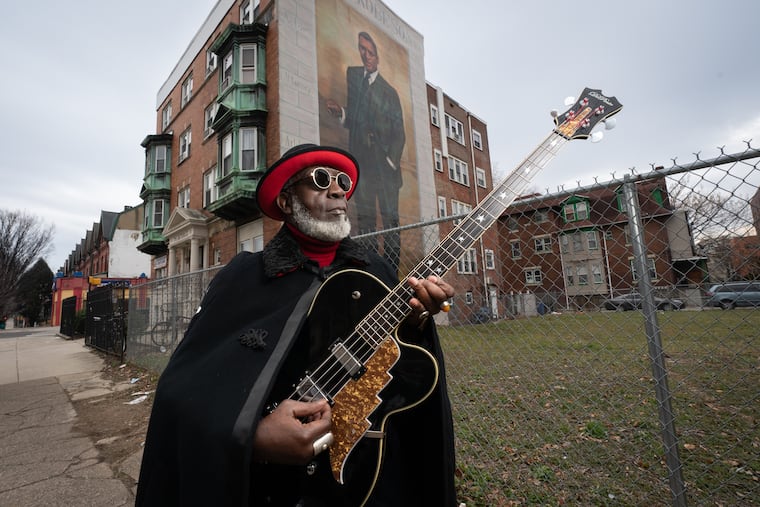
Jamaaladeen Tacuma isn’t particularly interested in dwelling on the fact that he’s just turned 70. It may be one of the few things the veteran bassist, whose seemingly limitless capacity for fascination belies his senior citizen status, isn’t interested in.
“I was always the kind of person that looked ahead,” Tacuma insisted. “I like to say, ‘What am I going to be doing in the future? How will I be thinking in the future?’”
He marked his June 13 birthday not with old friends, but by leading a never-before-assembled, multi-generational quintet with Pulitzer-winning drummer Tyshawn Sorey, saxophonist and Snacktime co-founder Yesseh Furaha-Ali, guitarist Keyanna Hutchinson, and pianist Yoichi Uzeki.
In July he’ll celebrate the release of a new all-star album with 102-year old saxophonist Marshall Allen at Grounds for Sculpture in New Jersey. Two months later, he’ll be back at South with Quantum Blues, an unlikely quartet teaming him with longtime Pharoah Sanders guitarist Tisziji Munoz, Living Colour drummer Will Calhoun, and former Late Show with David Letterman keyboardist Paul Shaffer.
But it’s not just music that captures his imagination. Before settling in for our interview last month at a Mexican restaurant on Passyunk, Tacuma was gushing about his recent viewings of vintage films from Japan’s Toho studio, giant monster movies like the original Godzilla and The Mysterians.
The lunch, he said, evoked memories of a visit to Mexico City, where he learned of the country’s lucha libre wrestling tradition. This, in turn, prompted the recording of an upcoming album, Bajo Libre.
That sort of thing happens constantly with Tacuma, who has a Zelig-like ability to find himself in unexpected musical situations.
On a recent trip to London, he was being shown around by drummer Sean Noonan, a frequent collaborator. While passing though the Liverpool Street tube station, his ear was caught by the guitar playing of a young busker. He immediately tasked Noonan with finding a studio and enlisted the 18-year old guitarist, Michael Asukyle, to record an impromptu album he called Mind the Outsiders, which was released last February.
After taking his grandson to see the Australian children’s group the Wiggles a few years ago, he bumped into the band over breakfast at Sabrina’s Cafe the next morning. By the time he got home they’d invited him into the studio to write and record the song “Play the Bass Guitar.”
He’s since joined them on stage and on television, and plans to reunite with the band this summer at the Miller Theater.
Tacuma’s friendship with current Rolling Stones drummer Steve Jordan — they met, he recalls, co-presenting an award to the Red Hot Chili Peppers — led to an eight-year gig in the house band for the Michael J. Fox Foundation’s annual gala fundraiser, where he’s played with the likes of Sheryl Crow, Stevie Nicks, Jackson Browne and Bob Weir.
Almost in spite of his compulsion to move perpetually forward, Tacuma’s 70th birthday year has occasioned a number of opportunities for revisiting the past, as well.
In January, the bassist returned to the site of the Norris Apartments housing project, where he grew up as Rudy McDaniel.
Joined by a group of local singers and musicians, many of whom he’d known since his early days in North Philly, he presented his “The Dream Then & Now” suite, dedicated to the Rev. Dr. Martin Luther King Jr. As Lawrence “Weas” Newton recited the civil rights leader’s words, Tacuma struck up a funk groove in the complex’s community center, a poster board nearby displaying photos of him playing in the same room as a teenager.
“It was surreal,” Tacuma laughed. “Weas and I grew up in the area. We used to play ball in the basketball courts right next door. A lot of groups came from that area, like Harold Melvin & the Blue Notes, the Stylistics, McFadden and Whitehead, Brenda & the Tabulations. And the Uptown Theater was right around the corner, so I saw everybody there whenever those shows would come to town — the Temptations, James Brown.”
The neighborhood not only nurtured Tacuma’s passion for music, but also inculcated his love of fashion.
“If folks had money, they would go downtown and go to Boyds,” he explained. “But for the most part, we would go to the Avenue, Germantown, and Lehigh. There you had all the stores, like Leo’s or Al Schaeffer’s Red Carpet Room.”
Tacuma later borrowed the name of one of those shops for his own home boutique, the Redd Carpet Room. There he sells the finds he brings home from his travels, where he can often be found at flea markets and vintage shops in the hours prior to a performance.
“I don’t take bass guitars on tour anymore,” he said. “I just bring a suitcase to fill with clothes. I’m serious about helping guys look a bit better.”
A month after his MLK Day performance, Tacuma played the Sons d’Hiver festival in Paris, where he revisited the hotel that had become the home base for Ornette Coleman’s Prime Time band 50 years earlier, during Tacuma’s first tour of Europe.
“We were supposed to go to Paris for two weeks, and we wound up staying for three months,” he recalled. “I hadn’t been back to that place since that time. The same family owned it. We had lunch right next door, at the same restaurant where Ornette and I used to have lunch, sitting at the same table. It brought back a lot of memories.”
Coleman played a foundational role in Tacuma’s musical life. After high school, he received a scholarship to attend Berklee School of Music, but declined.
“Because I wanted to be a musician that played on the road.”
Instead of college, he joined organist Charles Earland’s band but was fired after a year. He moved home, wondering what to do next, until a week later he received a call to audition for Coleman’s band.
“I learned so many things from Ornette,” he said. “As a bandleader, he wasn’t dictatorial but he knew what he wanted and he knew how to extract that from the members of the band. Also there was a seriousness about sound, the idea that if you really, truly hear something different, then you should express it. You don’t have to follow a trend.”
Those are lessons that Tacuma has carried with him over a remarkably diverse and unpredictable career spanning more than half a century. He has collaborated not just with a staggering variety of musicians but with visual artists, filmmakers, architects, and scientists.
When asked to take a moment to look back over it all, even he has to marvel.
“I think I’ve looked into the future so much,” he concluded, “that I have a lot of stuff now to look back on. I feel blessed that the creator has given me all this.”