
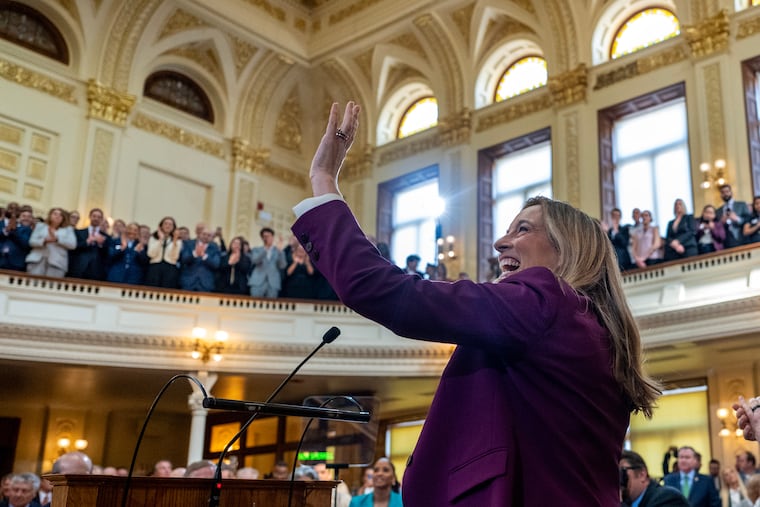
New Jersey Gov. Mikie Sherrill’s proposed budget would kick some seniors off a new property tax relief program, a move that she said would save the state hundreds of millions of dollars as the new Democratic governor looks for ways to address a projected $3 billion deficit this year.
Sherrill has pledged not to raise taxes, despite warning of a dire financial conditions if the state keeps its current course. But opponents say her proposed changes to a program designed to keep seniors in-state when they retire would function as a tax increase for some who just received relief.
She touted her budget proposal Tuesday as the “most fiscally responsible budget our state has seen in years” as she laid out her vision for the next fiscal year, which begins July 1.
Sherrill’s plan would expand mental health support for students at schools and assist first-time homeowners. It would also bring assistance to business owners from underrepresented communities while paring corporate tax breaks.
The former Navy pilot opened her speech with a moment of silence for service members killed or injured in the Middle East this month. Her budget also includes a proposal to increase housing for homeless veterans.
The Democratic governor will have to find consensus on how to address the budget gap while funding these new proposals through negotiations with the General Assembly and Senate, both of which are dominated by her party, ahead of a June 30 deadline.
“If there are things you think we need to add — come to me with places we can cut,” Sherrill told legislators. “It’s simple math: Any additions require subtractions.”
Some seniors would lose property tax relief
Seniors who own homes just started getting checks this year under a new program called Stay NJ. The program was designed to discourage seniors from moving out of state by refunding them as much as half of their property tax bills, up to $6,500.
Critics of the program say that it is expensive for the state and that the eligibility level of seniors making below $500,000 is too high. Sherrill agrees.
Her administration wants to slice the eligibility cap in half and make the program available only for seniors with an income below $250,000. The maximum benefit would be $4,000.
Standing in front of Assembly Speaker Craig Coughlin, a Central Jersey Democrat who championed the program, Sherrill said her modification would save taxpayers hundreds of millions of dollars a year.
“That’s a fairer, more efficient use of taxpayer money,” she said.
Stephen Sigmund, a spokesperson for Sherrill, said 90% of Stay NJ recipients would keep their benefits.
AARP quickly released a statement opposing the proposed change.
“The Stay NJ program was created to address New Jersey’s affordability crisis and deliver on a commitment to older residents who want to age in place,” the organization said. “As policymakers consider adjustments, it is critical that the program does not reduce the annual benefit and continues to provide meaningful relief while keeping the promise made to the people counting on it.”
Senior renters who make below $150,000 would continue to receive a $250 bonus as part of another property tax relief program, ANCHOR, but the bonus would not be extended to senior homeowners this year.
Kids would get more support at school amid social media and learning loss
Sherrill wants to fund various initiatives aimed at improving outcomes for kids at school as well as their mental health — issues she spoke about on the campaign trail that she said are personal to her as a mother of four. She said social media is “worse” than Big Tobacco.
“My four kids are between the ages of 14 and 20 years old,” she said. “And I can tell you with certainty: Our country is failing our children when it comes to protecting them online.”
She wants to allocate $33 million to a new youth mental health initiative that would expand mental health services in K-12 schools. This money would be directed to students with “high-acuity needs,” or kids facing severe mental health symptoms.
She also wants to dedicate $500,000 to create a new social media research center focused on young people’s mental health and $125,000 for the new New Jersey Office of Youth Online Mental Health Safety and Awareness, which she created within the state health department.
“The truth is, a new platform or feature rolls out every day, with the most advanced algorithms designed to addict us all,” she said. “Trying to keep up with this would be a full-time job, and the platforms know it.”
In an effort to address learning loss from the pandemic, Sherrill wants to allocate $15 million to “high-impact tutoring” that her administration says would help nearly 100 more districts and 13,500 more students.
Her administration says her proposal would also allow her to expand childcare assistance for up to 77,500 children, which would be 2,500 more than this fiscal year.
Sherrill wants to increase funding for schools and work with the legislature to make changes to the school funding formula, which could affect property taxes.
How her budget would affect business owners
Sherrill has championed trying to make the state’s processes easier for business owners trying to navigate its permitting and licensing systems. She wants to accelerate work underway by the New Jersey Innovation Authority — which uses AI and other digital tools to modernize government agencies and make them more user-friendly.
She wants to send $13.3 million to the authority to support modernizing the permitting system and creating an online “report card” in an effort to increase transparency over how state agencies are spending taxpayer money.
She also wants to reduce business registration fees, and dedicate $500,000 to train business owners from underrepresented groups on navigating the state’s processes.
She also wants to raise revenue by scaling back tax deductions for bigger companies. The Commerce and Industry Association of New Jersey raised concerns about the idea.
Sherrill wants big companies to make up for federal Medicaid cuts
Sherrill said 300,000 New Jerseyans will lose Medicaid because of new regulations under President Donald Trump’s One Big Beautiful Bill Act, which slashed social programs to help pay for tax cuts.
The new law requires many Medicaid recipients to file paperwork every six months to show they are complying with a work requirement for the program, which provides low-income Americans with health coverage.
She said that her budget will invest in technology to help people meet the new requirements, but that directly paying for those losing coverage would cost the state billions. She instead wants companies with 50 or more workers to cover employees on Medicaid or pay a fine, which she projects could raise $145 million.
Christina Renna, the president and CEO of the Chamber of Commerce Southern New Jersey, said the idea “will require serious scrutiny” before it moves forward.
“In a region that borders both Pennsylvania and Delaware, competitiveness is not theoretical — policies that raise the cost of doing business here have consequences that our neighbors are happy to absorb,” Renna added.
First-time homeowners and veterans facing homelessness
Sherrill believes her administration can reach every homeless veteran in the state this year. To reach this goal, she wants to direct $11 million to Bringing Veterans Home, a program that addresses veteran homelessness and has helped more than 2,200 homeless veterans since it was created in January 2025.
Her administration wants to spend $25 million to expand programs to address homelessness.
Sherrill also wants to help about 3,000 more first-time and first-generation homeowners by increasing funding for the state’s down payment assistance program by $5 million. She also wants to use $70 million to develop more affordable housing through the Affordable Housing Trust Fund.