
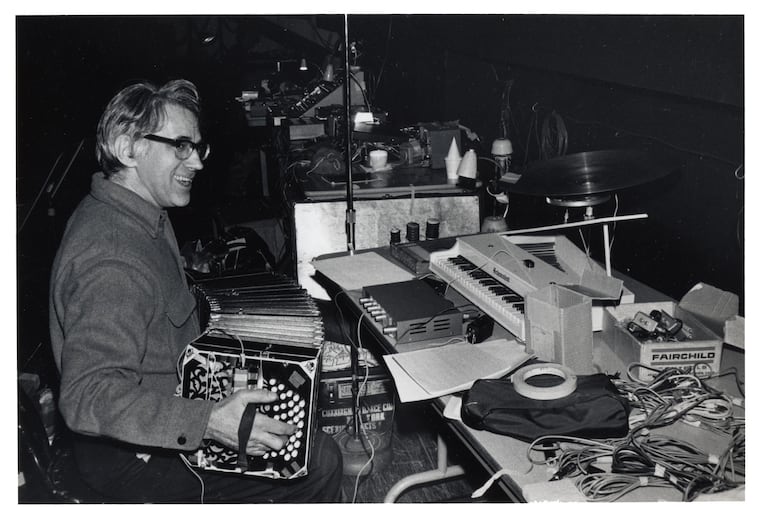
David Tudor was born in West Philly in 1926 and, at least for a musical prodigy, his career started out conventionally enough.
He began studying the piano at age 6 before switching his focus to the pipe organ at 11. By his mid-teens he was working regularly at places where you’d expect to find an organist — churches like St. Mark’s in Center City and Trinity Episcopal in Swarthmore, or playing the famed midday concerts at John Wanamaker’s department store.
But as exemplified by a recent concert of works associated with Tudor, presented by Bowerbird earlier this month at the Community Education Center, Tudor’s music became extremely unconventional over the course of his lifetime.
Just a few miles from the composer’s alma mater, Overbrook High, a half dozen musicians were seated emulating Tudor’s music making process, behind tables piled high with an impenetrable tangle of boxes, wires, knobs, and switches; electronic tendrils snaked from these sources to a bewildering array of objects: glass bowls, a suspended box fan, an oversized die, a copper pot still, even a tree. Each was connected to transducers that took advantage of their resonant properties, turning them into natural amplifiers.
A century after his birth and three decades since his death in August 1996, David Tudor’s music still seems like something created in a distant, if more analog, future.
Years before, the AI-generated “band” Velvet Sundown grabbed headlines by chalking up more than 1 million subscribers on streaming services and fooling journalists, Tudor was experimenting with machine-learning systems in the early ‘90s, working with engineers from Intel on a project called the Neural Network Synthesizer.
Those experiments evolved from Tudor’s work with the generation of contemporary classical composers that emerged in the decades after World War II, when he became the pianist and collaborator of choice for such groundbreaking artists as John Cage, Morton Feldman, Earle Brown, Merce Cunningham, and Robert Rauschenberg.
He was a particularly vital collaborator with Cage, who found in Tudor the ideal vehicle for the use of chance operations in his compositions.
The turning point for Tudor came at Settlement Music School in South Philly, where he studied with the pianist Irma Wolpe. The young pianist became close with Wolpe and her husband, the modernist composer Stefan Wolpe, and the couple introduced Tudor to new developments in modern music at the time.
An ongoing exhibition at Drexel University’s Pearlstein Gallery, “David Tudor: A View From Inside,” traces the roots of his iconoclastic approach to performance and composition back to his early days in Philly.
The pipe organ — an instrument that literally surrounds the performer, and that they play from within — proved to be a foundational influence on Tudor’s musical philosophy for the rest of his life, said Dustin Hurt, co-curator and director of Philly presenting organization Bowerbird.
“That led to the more metaphorical angle of David’s music, which involved discovering what the instruments do on their own,” said Hurt. “That’s the ‘View From Inside.’ He’s not saying, ‘I want to make this music, let me find the instruments that do it.’ He’s saying, ‘This is the stuff that I have. Let’s see what it does.’”
Discovering Tudor’s fascination with puzzles, composers presented him with scores that offered problems to solve rather than music to play. The exhibition includes mind-boggling lists of calculations and measurements that the pianist meticulously assembled in preparation of performing certain pieces.
By the 1960s, he started to abandon the piano altogether, modifying small electronic devices to craft unpredictable music from feedback.
“Tudor was such a skilled virtuoso on the piano, but he showed no interest in performing the classical repertoire,” said co-curator You Nakai, a professor at the University of Tokyo and author of Reminded By the Instruments: David Tudor’s Music.
“He would only perform scores that challenged him to solve them and produce music that the composer never really thought of,” said Nakai. “So when he started making his own instruments, he strongly focused on ways to implement indeterminacy within the workings of the instruments themselves.”
Composer Stanley Lunetta includes the following instructions in his “Piece for Bandoneon and Strings”: “If you are already David Tudor, you will have no problem performing this piece; if you are not David Tudor, you must study hard, for you must be him during this performance.”
The strings in the piece were not the expected violins and cellos, but tethers from Tudor’s limbs to a group of puppeteers who triggered him to play sections of Lunetta’s score.
Gradually, Tudor’s vision of an instrument that could be inhabited grew in scale far beyond even a department store-sized pipe organ. For Expo ‘70, the 1970 world’s fair in Osaka, Japan, he transformed an entire building into an instrument by mounting loudspeakers in the dome of the Pepsi Pavilion. A few years later, he drew up plans to convert an entire island into an instrument by recording the natural sounds of the space, manipulating them, and playing them back via speakers scattered throughout the island.
That project wasn’t realized until 2024, long after his passing, off the coasts of Japan and Norway via a collaborative project spearheaded by Nakai.
Tudor’s pioneering experiments with electronic music seemed to make him an apt collaborator for the Intel engineers and their new neural network chip, but his interest in the technology was diametrically opposed to theirs.
For all his love of puzzles, “Tudor showed no interest in repeating his past,” said Nakai.
“He opened it up, went inside the circuitry and figured out how to let the instrument speak for itself. He didn’t understand everything, but he didn’t need to because he was making music that he liked.”
“David Tudor: A View From Inside” runs through March 21, Pearlstein Gallery in Drexel University’s URBN Annex, 3401 Filbert St. bowerbird.org